
Skin Ageing Treatment in Singapore:
Causes, Signs & Effective Treatment Options
You may begin to notice more prominent lines around the eyes, a complexion that appears dull despite a good night’s sleep. Your skin may feel drier, makeup may not sit as smoothly, or your face may appear less firm and refreshed than it used to.
These are common signs of skin ageing. But getting older is only part of the picture.
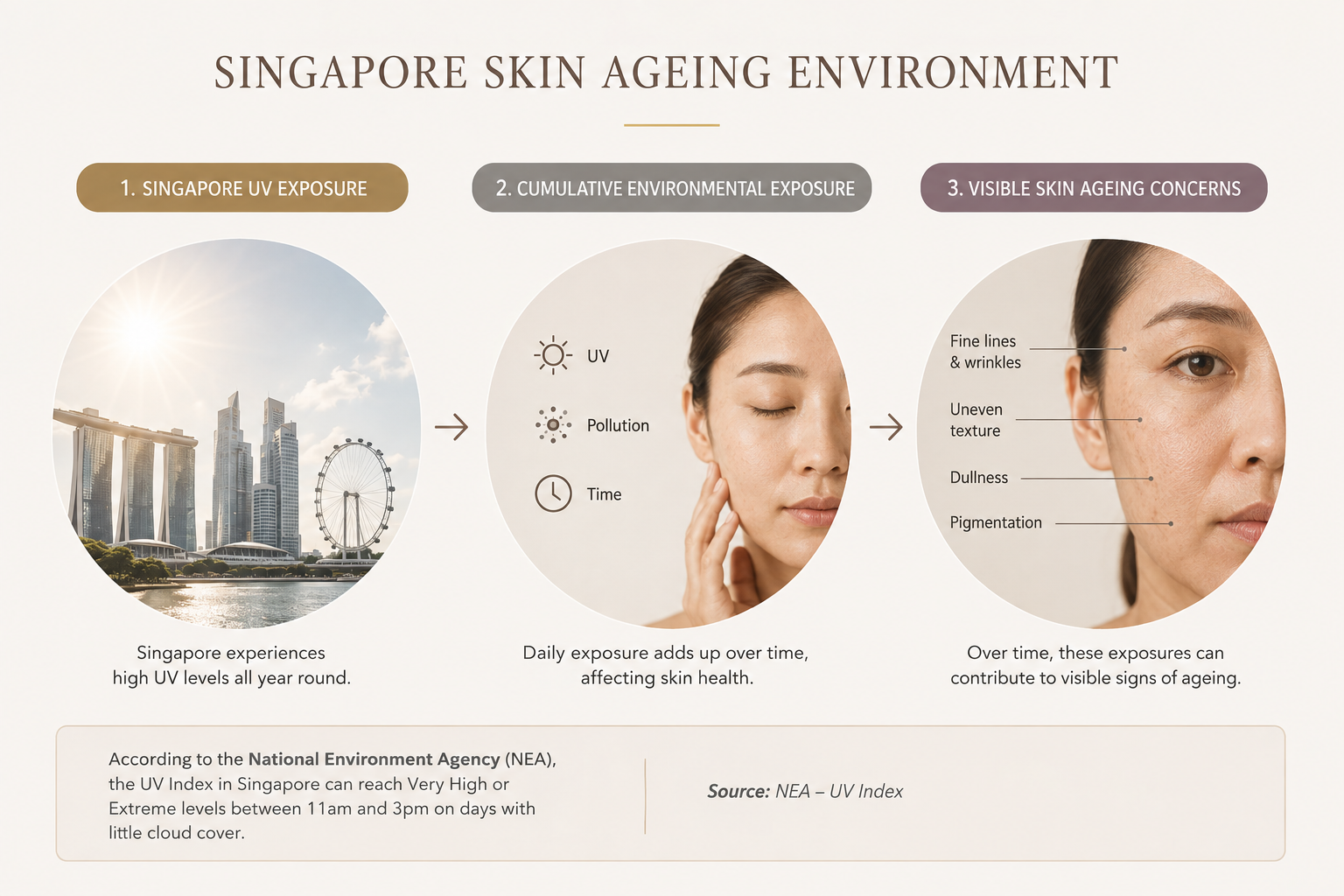
Sun exposure, lifestyle and environmental factors can influence how visible these changes become. This is particularly relevant in Singapore, where the UV Index can reach Very High or Extreme levels between 11am and 3pm on days with little cloud cover.
At HAACH, we commonly begin by understanding the individual’s skin condition and concerns before recommending a facial treatment. Two people may describe the same concern — such as dullness, dryness or fine lines — while having quite different underlying skin conditions and treatment goals. The assessment therefore helps determine which treatment approach may be more suitable rather than choosing a facial simply because it is labelled an “anti-ageing” treatment.
When people search for skin ageing treatment in Singapore, they are often looking for more than a way to address wrinkles. They may want to improve the appearance of dullness, dehydration, uneven texture, pigmentation, loss of firmness or skin that simply does not look as refreshed as it once did.
This guide explains what happens to skin as we age, why Singapore’s environment matters, the main treatment approaches available, and where FountainCell™ at HAACH fits within the wider skin rejuvenation landscape.
What Is Skin Ageing?
Skin ageing is the gradual change in the skin’s structure and appearance over time.
Some changes are part of natural ageing, while others are influenced by external factors such as ultraviolet (UV) exposure and lifestyle.
As skin ages, it can become drier and changes in elasticity, firmness, texture and facial fullness may become more noticeable. The visible pattern is different from person to person, which is why two people of the same age can have very different-looking skin.
One person may mainly notice fine lines. Another may be more concerned about dryness and dullness. Someone else may notice pigmentation, uneven texture or a gradual loss of firmness.
At HAACH, we often see clients who describe a specific visible concern even though the underlying skin condition may differ from person to person. Someone mainly concerned about dehydration may need a very different approach from someone looking for targeted treatment for pigmentation or significant loss of firmness.
This is why assessment matters. The aim is not simply to label a concern as “ageing skin”, but to understand what the individual is actually noticing and what they want to improve
7 Common Signs of Skin Ageing
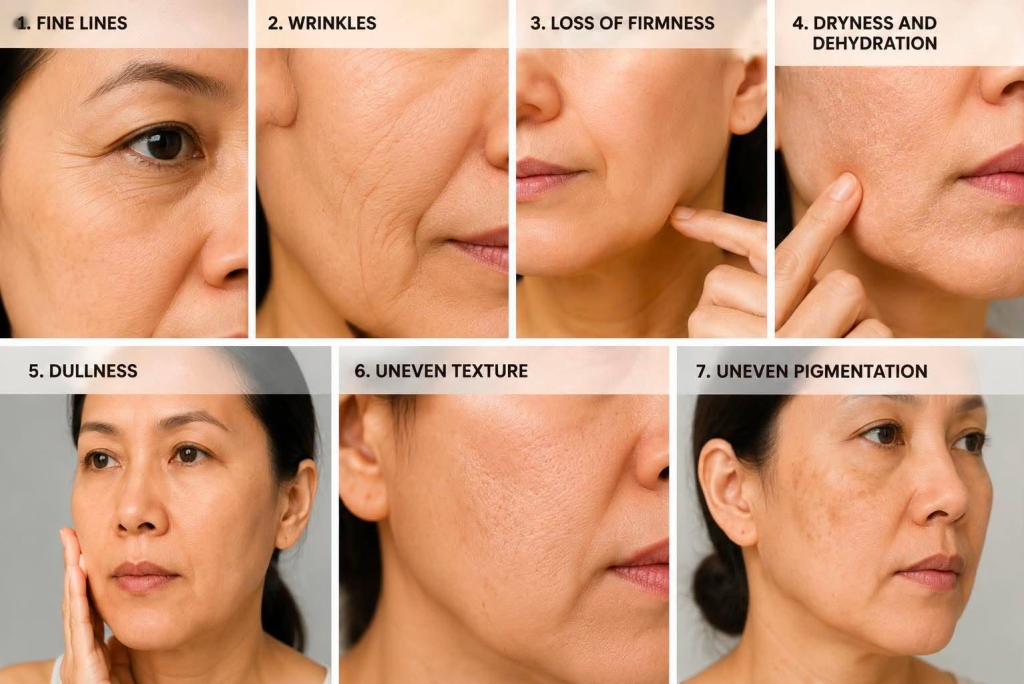
Skin ageing does not always begin with obvious wrinkles. You may first notice that your skin feels drier, looks less radiant, or no longer appears as smooth and firm as it once did. These changes can develop gradually, and different people may notice different signs depending on their skin condition, lifestyle and cumulative sun exposure.
1. Fine Lines
Fine lines often become noticeable around the eyes, forehead and mouth.
Repeated facial movement and cumulative environmental exposure can contribute to their appearance, while UV exposure is a major factor in premature visible skin ageing.
2. Wrinkles
Over time, some fine lines become deeper and more noticeable, particularly in areas that experience repeated facial movement. Wrinkles are a normal part of ageing, but their appearance can also be influenced by environmental exposure and lifestyle.
3. Loss of Firmness
Ageing skin may gradually appear less firm or supple. Some people describe this less as "wrinkles" and more as their skin looking less taut or less lifted than it once did.
4. Dryness and Dehydration
Skin can become drier with age. Dehydrated skin may also make fine lines appear more noticeable. Moisturising helps the skin retain water and can temporarily improve the appearance of some fine lines.
5. Dullness
A complexion that once looked naturally fresh may begin to look tired or less radiant. Dullness can have several contributing factors, including dryness, environmental exposure and the natural changes associated with ageing.
6. Uneven Texture
The skin may gradually feel less smooth. Dryness, accumulated surface cells and age-related changes can contribute to a rougher or less even-looking complexion.
7. Uneven Pigmentation
Cumulative sun exposure can contribute to pigmentation changes and an uneven-looking skin tone. UV exposure is one of the key environmental contributors to premature skin ageing.
What Causes Skin Ageing?
There is rarely one reason why someone starts noticing changes in their skin.
Usually, several factors overlap.
Natural Ageing
Intrinsic ageing is the natural process that happens over time. As we age, changes in skin structure, hydration, elasticity and firmness can become more noticeable. Genetics also influence how these changes appear.Natural ageing cannot be stopped completely. A more realistic approach is to protect the skin from avoidable environmental stressors while addressing the cosmetic concerns that matter to you.
UV Exposure
If there is one environmental factor worth paying particular attention to, it is the sun.
Repeated UV exposure accumulates over time and can contribute to visible photoageing, including wrinkles and pigmentation changes. HealthHub specifically notes that excessive sunlight exposure can contribute to premature ageing, wrinkling and brown pigmentation.
This is why an anti-ageing skincare routine should not begin and end at a facial clinic.
Daily sun protection remains one of the foundations of long-term skin care. Singapore's NEA advises sun protection measures including sunscreen of at least SPF 30, shade and protective clothing, particularly during periods when UV levels are highest.
Environmental Factors
Skin is exposed to the environment every day.
Heat, humidity, air-conditioning, outdoor exposure and urban pollutants can all affect how skin feels and looks.
These factors do not mean that living in a city automatically causes premature ageing. They are simply part of the environment your skin experiences every day.
Lifestyle
Lifestyle factors can also contribute to premature visible ageing.
Smoking, for example, is associated with premature skin ageing. A broader approach to skin maintenance therefore includes sun protection, moisturising, a consistent skincare routine and avoiding smoking.
Changes in Skin Renewal
The skin's natural processes also change with age.
Over time, this can contribute to differences in hydration, texture and overall appearance.
Why Can Skin Ageing Be More Noticeable in Singapore?
Singapore’s tropical environment makes sun protection particularly important.
According to Singapore’s National Environment Agency, the UV Index can commonly reach Very High or Extreme levels between 11am and 3pm when there is little cloud cover.
And UV exposure is not limited to beach trips.
It can happen while walking to lunch, commuting, exercising outdoors, travelling between appointments or simply spending time outside.
Over years, cumulative UV exposure can contribute to photoageing.
Singapore’s heat and humidity can also affect how your skin feels throughout the day. Someone may have oily-looking skin but still experience dehydration, while another person may find that their skin becomes dry or uncomfortable in air-conditioned environments.
This is why a sensible skin ageing strategy starts with the basics:
Sun protection + consistent skincare + professional care when appropriate
A facial should complement these habits, not replace them.
What Is Skin Ageing Treatment?
Skin ageing treatment refers to professional and at-home approaches intended to improve the appearance of visible signs associated with ageing, including fine lines, dryness, dullness, uneven texture, pigmentation and loss of firmness.
There is no single skin ageing treatment in Singapore that is best for everyone.
At HAACH, we often see clients who describe a specific concern even though the underlying skin condition may differ from person to person. Someone mainly concerned about dehydration may need a very different approach from someone looking for targeted treatment for pigmentation or significant loss of firmness.
This is why our assessment looks beyond the symptom itself when determining an appropriate treatment approach.
The starting point should be your skin condition, your concerns and your treatment goals.
What Are the Main Types of Skin Ageing Treatments in Singapore?
Singapore offers a wide range of options, from everyday skincare to professional facial treatments and medical aesthetic procedures.
They are not interchangeable.
Daily Skincare
A consistent home routine forms the foundation of long-term skin maintenance.
Depending on your needs, this may include:
- Cleanser
- Moisturiser
- Antioxidant products
- Targeted skincare
- Daily sunscreen
Singapore’s HealthHub recommends broad-spectrum sunscreen with at least SPF 30 and highlights the role of UVA exposure in skin ageing and wrinkling.
Hydration-Focused Facials
These treatments focus primarily on skin conditioning and hydration.
They may appeal to people whose main concerns include:
- Dryness
- Dehydration
- Tight-feeling skin
- Dullness
- A tired-looking complexion
Exfoliation Treatments
Exfoliation focuses on the skin’s surface and may help improve the appearance of dullness and uneven texture.
The type and intensity should be appropriate for the individual’s skin condition.
Skin Firming and Tightening Treatments
Some professional treatments focus specifically on the appearance of firmness and tightness.
The technologies used can vary significantly, as can their intensity, suitability and recovery requirements.
Medical Aesthetic Treatments
Medical aesthetic procedures may be considered for more specific concerns and should be performed following an appropriate medical assessment.
These are different from beauty facials and should not be treated as interchangeable options.
Skin Rejuvenation Facials
Rejuvenation-focused facials generally take a broader approach to the appearance and condition of the complexion.
Depending on the treatment, this can include cleansing, exfoliation, hydration, specialised formulations and delivery technologies.
FountainCell™ at HAACH sits within this professional skin rejuvenation category.
At HAACH, our approach is to assess the individual’s skin condition before recommending a treatment. Depending on the person’s concerns and suitability, our team may recommend an appropriate FountainCell™ treatment or another treatment approach. Treatment recommendations are therefore not based solely on the symptom described, but on the individual’s skin condition and goals.
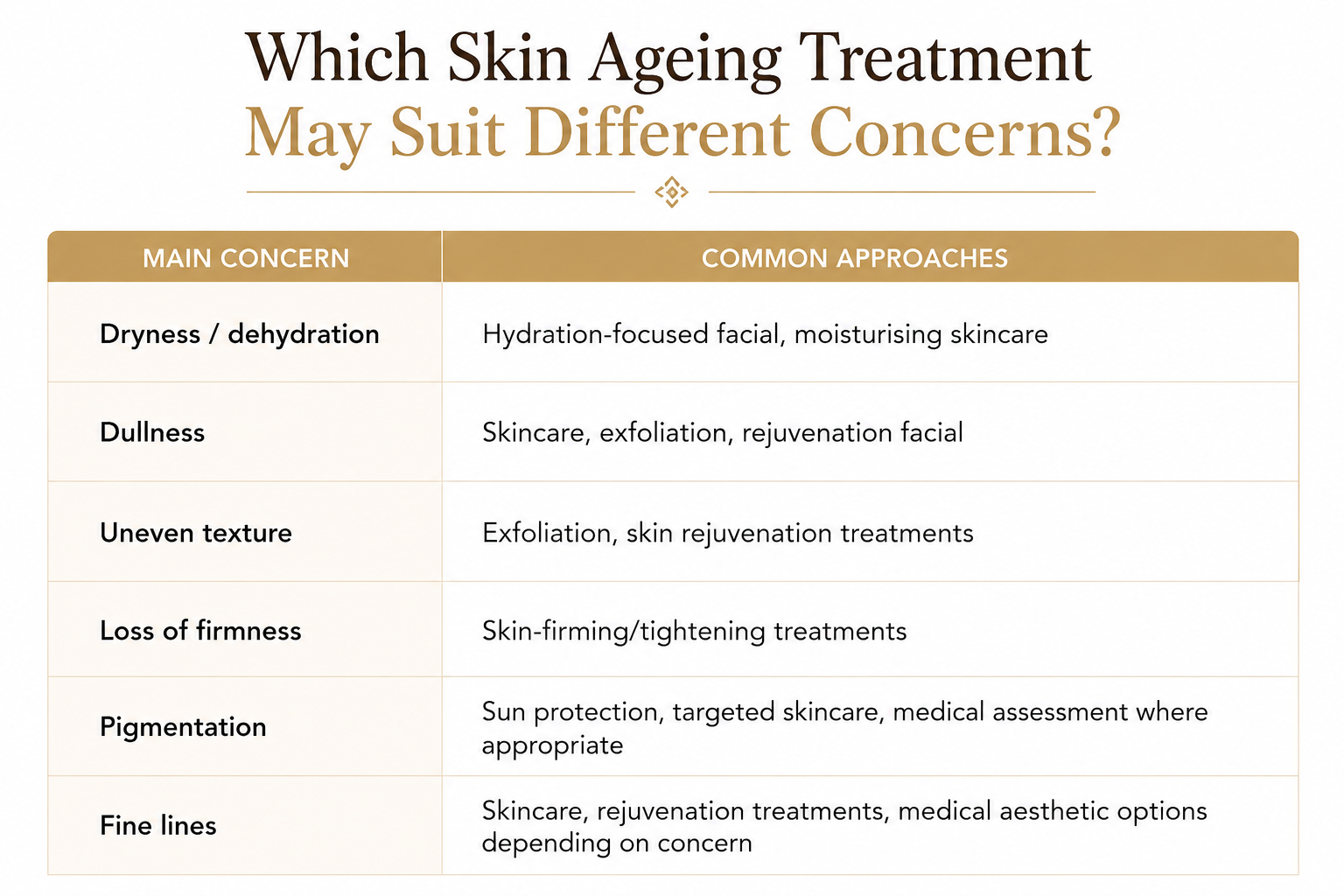
There is no universal “best” treatment.
The table is intended as a guide rather than a diagnosis or guarantee of suitability.
The most appropriate approach depends on your skin condition and the cause of the concern.
FountainCell™ at HAACH: A Skin Rejuvenation Approach
At HAACH, FountainCell™ is a specialised skin rejuvenation approach built around the FountainCell™ formulation and NanoJet™ technology.
HAACH describes FountainCell™ as being formulated to support skin resilience, reduce the appearance of fine lines and uneven texture, and enhance overall clarity and hydration.
Rather than treating skin ageing as one single concern, the FountainCell™ range includes different treatment approaches for different skin needs.
These include:
- FountainCell™ Anti-Ageing Therapy — focused on visible signs of ageing, firmness, elasticity and hydration
- FountainCell™ Glow Therapy — focused on dullness, radiance and texture
- FountainCell™ Hydration Therapy — focused on moisture and skin hydration
- FountainCell™ Purifying Therapy — focused on excess oil, clogged pores and congestion
This distinction is important because someone searching for an “anti-ageing facial” may not necessarily need the same treatment as someone whose main concern is dehydration or dullness.
What Is the FountainCell™ Regenerative Bio-Cell Ampoule?
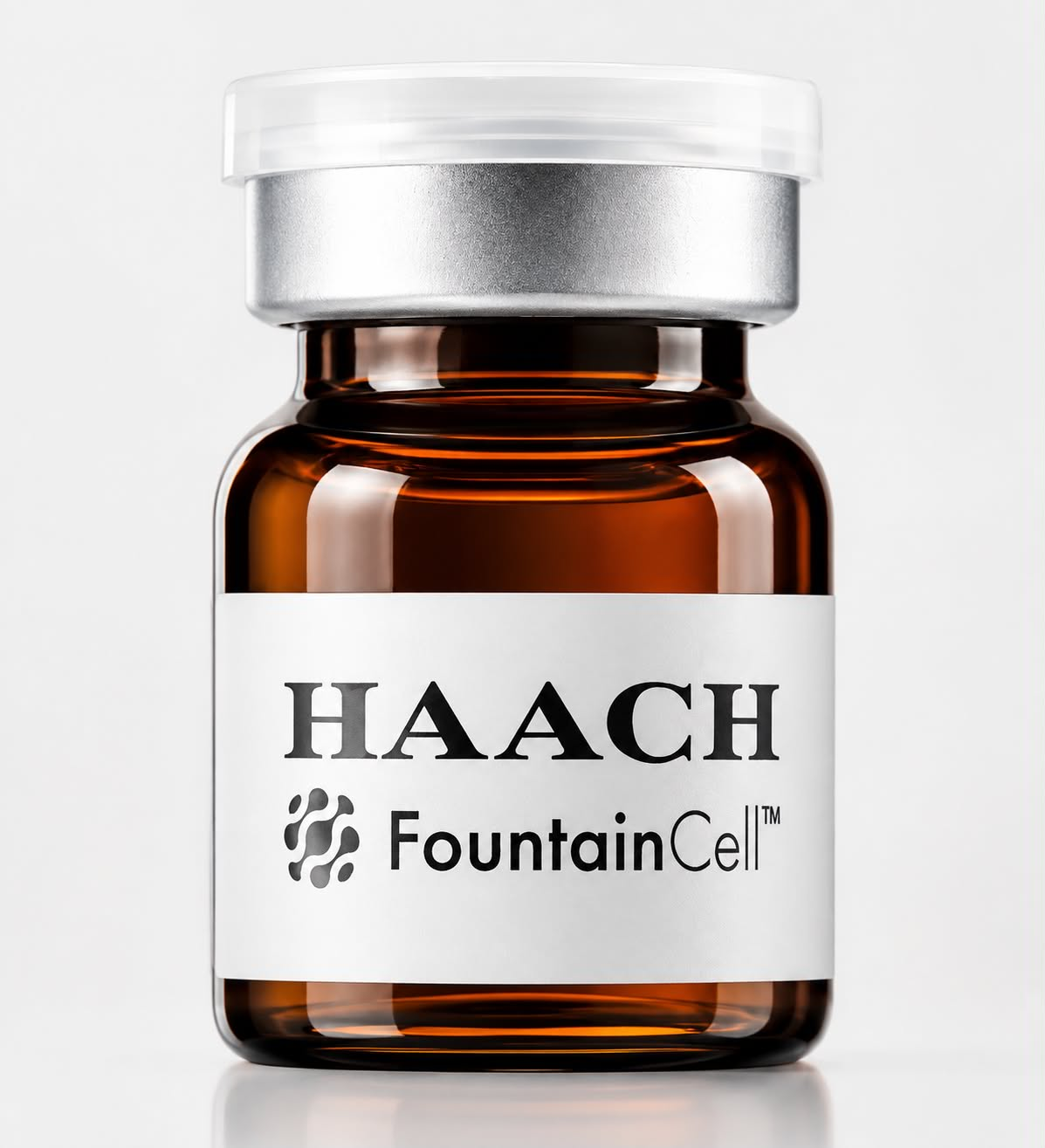
The FountainCell™ formulation is at the centre of HAACH’s FountainCell™ treatment approach.
HAACH describes FountainCell™ using regenerative bioactive-cell technology and positions the formulation around skin renewal, resilience, hydration, texture and visible signs of ageing.
HAACH’s published material also describes FountainCell™ as incorporating bioactive stem-cell technology.
For consumer-facing content, it is important to distinguish this cosmetic skin rejuvenation treatment from medical stem-cell therapy. FountainCell™ is presented by HAACH as part of a professional facial and skin rejuvenation experience rather than as a medical regenerative procedure.
What Is NanoJet™ Technology?
NanoJet™ is HAACH’s needle-free delivery technology used to apply FountainCell™ during the treatment.
HAACH’s FountainCell™ treatment pages describe NanoJet™ as the technology used to infuse FountainCell™ as part of the facial experience.
This is one of the features that distinguishes the FountainCell™ experience from a conventional facial.
Importantly, needle-free does not mean that every treatment step will feel identical for every person. The overall sensation depends on the treatment performed and the individual.
Who May Consider FountainCell™?
FountainCell™ may be considered by people whose cosmetic concerns include:
- Fine lines and visible signs of ageing
- Dull or tired-looking skin
- Reduced radiance
- Dehydration
- Uneven-looking texture
- Skin that appears less firm or supple
- Excess oil or congestion, depending on the FountainCell™ treatment selected
HAACH’s different FountainCell™ treatments are designed around different concerns. For example, its Anti-Ageing Therapy is positioned for ageing and dry skin, Glow Therapy for dull or uneven-looking skin tone, and Purifying Therapy for oily, acne-prone or congested skin.
Age by itself is not a reason to have FountainCell™.
Your skin condition and actual concerns matter more than the number on your birthday cake.
If you have persistent irritation, unexplained pigmentation, a changing skin lesion or another medical skin concern, medical assessment may be more appropriate than a cosmetic facial.
What Happens During a FountainCell™ Treatment?
One of the most useful questions to ask before booking any facial is:
“What is actually going to happen when I arrive?”
The exact experience depends on the FountainCell™ treatment selected. HAACH publishes different treatment sequences for its FountainCell™ therapies, so it would be misleading to describe one fixed protocol for every client.
For example, HAACH’s published FountainCell™ Anti-Ageing Therapy describes a 90-minute treatment beginning with a double cleanse, followed by gentle exfoliation, FountainCell™ infusion through NanoJet™ technology, RF therapy and a face-and-shoulder massage.
1. Skin Assessment and Treatment Selection
The first consideration is your skin condition and the concern you want to address.
HAACH’s treatment offering is designed around different concerns rather than treating every client with exactly the same facial.
This is why the treatment selected may differ between someone primarily concerned about fine lines and someone whose main concern is dullness, dehydration or congestion.
2. Skin Preparation
The treatment sequence can include cleansing and exfoliation.
For the Anti-Ageing Therapy, HAACH describes a double cleanse followed by gentle exfoliation.
Other FountainCell™ treatments may use different preparation steps. For example, HAACH’s Purifying Therapy describes double cleansing and diamond peel exfoliation.
3. FountainCell™ Infusion
The FountainCell™ formulation is incorporated into the facial through HAACH’s NanoJet™ technology.
This is the central delivery component of the FountainCell™ experience and is described by HAACH as a needle-free approach.
4. Treatment-Specific Technology
Additional technology may depend on the FountainCell™ treatment selected.
For example, HAACH’s Anti-Ageing Therapy incorporates RF therapy as part of the treatment and positions it around lifting and firming the appearance of the skin.
5. Massage and Finishing Steps
HAACH’s Anti-Ageing Therapy includes a face and shoulder massage after the infusion and RF stage.
Other FountainCell™ therapies can have different finishing steps.
The Purifying Therapy, for example, describes a soothing massage and nourishing mask as part of its treatment sequence.
6. Aftercare and Follow-Up
Aftercare depends on the treatment performed and your skin condition.
Rather than assuming that every client receives identical instructions, ask your HAACH therapist what you should avoid immediately after your treatment, when makeup can be applied and when your next treatment would be appropriate.
HAACH’s individual FountainCell™ treatment pages currently recommend treatment intervals of approximately every 3–4 weeks for several FountainCell™ therapies, while also advising clients to discuss personal skin goals with the skincare team.
How Often Should You Have a Skin Rejuvenation Treatment?
There is no universal schedule that applies to everyone.
Treatment frequency can depend on:
- Skin condition
- Primary concerns
- Treatment intensity
- Existing skincare routine
- Individual response
- Long-term goals
For some people, professional facials form part of an ongoing maintenance routine.
Others may only seek professional treatment when their skin needs additional attention.
Instead of asking:
“How often should everyone get a facial?”
a more useful question is:
“What treatment frequency makes sense for my skin and my goals?”
A consultation can help answer that.
Skin Ageing Treatment in Singapore: The Takeaway
Skin ageing is a normal part of getting older.
The goal of skin rejuvenation is not necessarily to make your skin look as though it has never aged.
For many people, it is much simpler:
They want their skin to look healthy, hydrated, smooth and refreshed.
That starts with the basics.
Protect your skin from Singapore’s strong UV exposure. Maintain a consistent skincare routine. Keep your skin appropriately moisturised. And when you want professional care, choose a treatment based on your actual concerns rather than simply choosing the most intensive option.
For those considering a specialised professional facial, FountainCell™ at HAACH combines its FountainCell™ formulation with NanoJet™ delivery technology, with different treatment approaches available for concerns ranging from visible ageing and dullness to hydration and congestion.
The best place to start is not with a treatment name.
Start with your skin. Understand what has changed. Then choose the approach that makes sense for you.
Explore FountainCell™ at HAACH
Concerned about dullness, dehydration, uneven texture or visible signs of skin ageing?
Speak with HAACH about whether FountainCell™ is suitable for your skin and treatment goals.
BOOK AN APPOINTMENT
Book your appointment now at a HAACH branch near you.
Frequently Asked Questions (FAQ)
Skin rejuvenation generally refers to approaches intended to improve the appearance and condition of the skin, including hydration, texture, radiance and visible signs of ageing. “Anti-ageing treatment” is a broader term often used for approaches targeting visible concerns such as fine lines, wrinkles, pigmentation and loss of firmness. The terms can overlap, but they do not necessarily describe the same treatment.
A facial can form part of an ageing-skin routine, particularly when the focus is hydration, conditioning, texture or radiance. However, a facial should not be expected to stop the natural ageing process. Daily skincare and sun protection remain important between professional treatments. Singapore’s HealthHub recommends broad-spectrum sunscreen with at least SPF 30 and highlights the role of UV exposure in premature ageing and wrinkling.
There is no universal starting age. Daily sun protection and appropriate skincare are useful at any age. Professional treatments can then be considered when specific cosmetic concerns appear or when you want additional skin maintenance.
The more useful question is not: “Am I old enough?” but: “What is my skin actually telling me?“
FountainCell™ may be considered by people concerned about visible signs of ageing such as fine lines, dullness, dehydration, uneven texture and reduced-looking radiance. HAACH’s Anti-Ageing Therapy is specifically positioned around visible ageing concerns, firmness, elasticity and hydration. Suitability should still be considered individually based on skin condition and treatment goals.
Age alone does not determine suitability. Someone in their 20s may have very different concerns from someone in their 50s. FountainCell™ also includes treatments designed around concerns such as dullness, hydration and congestion rather than ageing alone. A professional assessment can help determine whether a particular FountainCell™ treatment is appropriate for the individual’s concerns.
FountainCell™ uses HAACH’s NanoJet™ needle-free delivery technology rather than conventional needle injections. The sensation can vary depending on the treatment steps performed and the individual. If you are concerned about discomfort, ask your HAACH therapist to explain what you should expect before treatment.
The expected recovery experience depends on the treatment performed and your individual skin condition. Because HAACH offers different FountainCell™ therapies with different treatment steps, it is better to ask about the specific treatment you are booking rather than assume that every FountainCell™ session has the same downtime.
There is no single schedule that applies to everyone. HAACH currently recommends approximately every 3–4 weeks for several FountainCell™ treatments, while advising clients to discuss their personal skin goals with the skincare team. Your treatment frequency may therefore depend on your skin condition, treatment selected and longer-term goals.
FountainCell™ is described by HAACH using regenerative bioactive-cell and bioactive stem-cell terminology. However, it should not be confused with medical stem-cell therapy or a medical regenerative medicine procedure. For consumers, FountainCell™ should be understood in the context in which HAACH offers it: as a professional cosmetic skin rejuvenation treatment.