
Skin Ageing in Singapore:
How Sun Exposure, Humidity & Pollution Affect Your Skin

Introduction
Living in Singapore means your skin can move between very different environments in a single day.
You might walk from the MRT in the heat, spend hours in an air-conditioned office, then head outdoors again at lunchtime. Your skin may feel oily in the afternoon but tight or dry by evening.
Over time, you may also notice that your skin doesn’t look quite the same as it did a few years ago.
Fine lines may become easier to see. Pigmentation may become more noticeable. Your complexion may look duller, or your skin may not appear as firm and supple as before.
Not all of these changes are caused by Singapore’s climate. Natural ageing is still a fundamental part of the process. However, environmental exposure and lifestyle can contribute to premature visible skin ageing.
UV exposure deserves particular attention. Singapore’s UV Index can commonly reach Very High and Extreme levels between 11am and 3pm when there is little cloud cover.
So what does living in Singapore actually mean for ageing skin?
And if sunscreen and everyday skincare aren’t addressing the cosmetic concerns you want to improve, when might a professional skin ageing treatment be worth considering?
This guide looks at the factors that can affect how ageing skin appears in Singapore, practical ways to protect your skin, and where professional skin rejuvenation treatments such as HAACH’s FountainCell™ therapies may fit into a broader skincare routine.
Quick Answer: Does Living in Singapore Affect Skin Ageing?
Yes. Living in Singapore can contribute to premature visible skin ageing, with cumulative UV exposure being one of the most important environmental factors. Heat, sweating, humidity, air-conditioning and lifestyle can also affect how your skin looks and feels, although they should not be treated as direct causes of biological ageing.
The fundamentals are simple:
- Protect your skin from UV exposure
- Keep your skin appropriately hydrated
- Cleanse without unnecessarily stripping the skin
- Maintain a consistent skincare routine
- Avoid smoking
- Get adequate sleep and maintain healthy lifestyle habits
Professional skin treatments can also be considered when you want additional cosmetic care for concerns such as dullness, dehydration, fine lines or reduced-looking firmness.
At HAACH, FountainCell™ treatments are available for different concerns, including Anti-Ageing, Hydration, Glow and Purifying therapies.
What Does Skin Ageing Actually Mean?
Skin ageing isn’t one single change.
As we get older, the skin naturally changes. It can become drier, fine lines and wrinkles can become more apparent, and skin may gradually appear less firm.
This is often described as intrinsic ageing — the natural ageing process.
There is also extrinsic ageing, where environmental exposure and lifestyle factors contribute to visible changes over time. UV exposure is one of the most important contributors to premature skin ageing, while factors such as smoking can also accelerate visible ageing.
This distinction is useful because you cannot stop natural ageing.
You can, however, take steps to reduce some of the avoidable factors that contribute to premature visible ageing.
How Singapore's Climate Can Affect Your Skin
Heat and Sweating
If you’ve ever walked from the MRT to your office in Singapore’s midday heat, you know how quickly your skin can become sweaty.
Sweat itself isn’t necessarily harmful.
The challenge is that sweat can mix with sebum, sunscreen, makeup and environmental particles, leaving your skin feeling sticky or congested.
That doesn’t mean you should scrub harder or cleanse repeatedly.
Over-cleansing can leave the skin feeling dry and uncomfortable, creating another problem.
The aim is to keep the skin clean without unnecessarily stripping it.
Does Humidity Make Your Skin Age Faster?
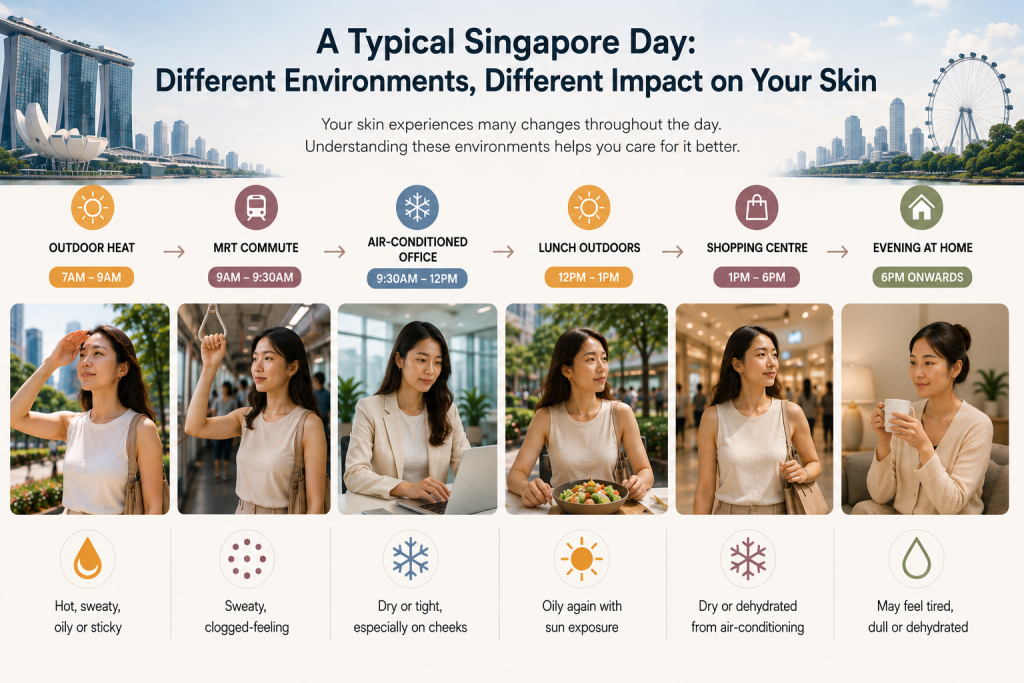
Humidity itself is not a direct cause of skin ageing.
Singapore’s humid environment can, however, affect how your skin behaves.
You may sweat more and feel oilier outdoors, while spending several hours in air-conditioning can make your skin feel dry or tight.
This is one reason Singapore’s climate can make skin concerns feel confusing.
Your skin doesn’t necessarily have to be simply “oily” or “dry.”
Why Oily Skin Can Still Feel Dehydrated
Consider a typical Singapore workday. You wash your face before leaving home. By lunchtime, your forehead or T-Xone is shiny.
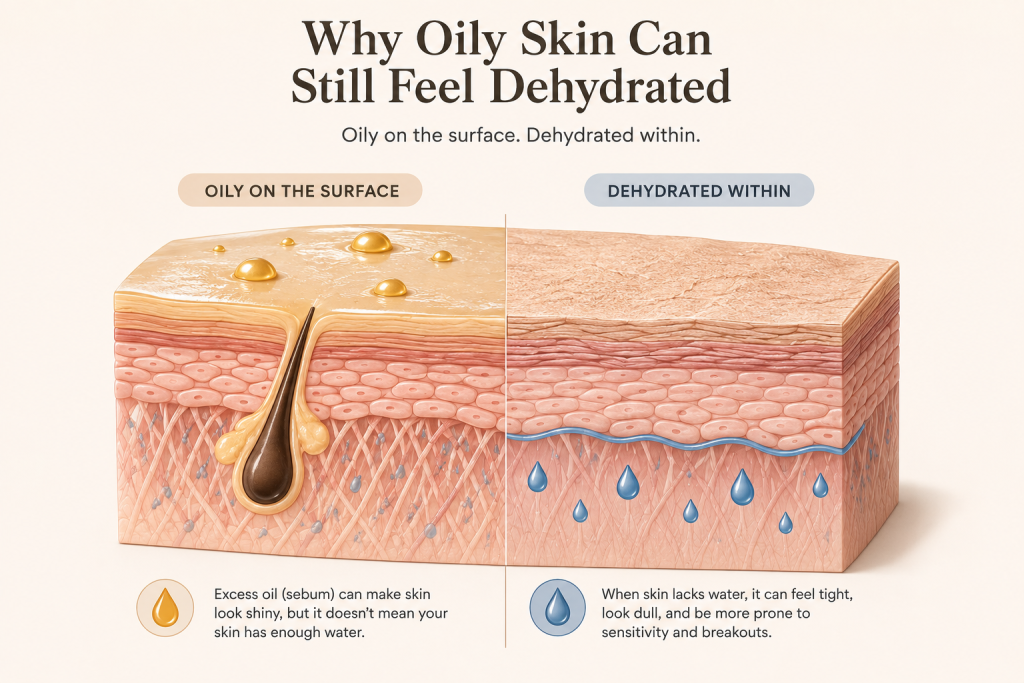
After several hours in an air-conditioned office, however, your cheeks feel tight.
It can be tempting to think:
“My skin is oily, so I need a stronger cleanser.”
Not necessarily. Oil and hydration are different things. Sebum is an oily substance produced by the skin, while hydration refers to the skin’s water content. This means you can have oily-looking skin and dehydrated-feeling skin at the same time.
If your skin repeatedly feels tight after cleansing, looks rough or shows fine lines more prominently when dry, your routine may need more attention to hydration rather than simply stronger oil control.
Air-Conditioning and Ageing Skin
Singapore’s outdoor environment is humid, but many people spend much of their day moving between outdoor and indoor spaces. A typical weekday might begin with a walk through the heat to the MRT, followed by several hours in an air-conditioned office, a trip outdoors for lunch, and then more time in air-conditioned environments such as a car or shopping centre before heading home.
These changes in temperature and humidity can affect how your skin feels throughout the day. Your skin may feel comfortable or slightly oily when you are outdoors, but after spending several hours in air-conditioning, your face may start to feel tight or dry.
Air-conditioning itself does not mean you need to change your lifestyle or avoid indoor environments. Instead, it is worth considering how your skincare routine supports your skin as it moves between the different environments you experience every day.
UV Exposure and Visible Skin Ageing
If there is one environmental factor to prioritise when discussing premature skin ageing, it is UV exposure.
Singapore’s National Environment Agency notes that the UV Index commonly reaches Very High and Extreme levels during the four-hour period between 11am and 3pm when there is little cloud cover.
The American Academy of Dermatology also identifies UV exposure as a major contributor to premature skin ageing, including wrinkles and age spots.
You don’t need to spend an entire afternoon at the beach to accumulate UV exposure.
It can happen during ordinary activities:
- Walking to lunch
- Waiting for a bus
- Walking from the MRT
- Driving
- Outdoor exercise
- Running errands
- Sitting outdoors at a café
One afternoon won’t suddenly make your skin look older.
The concern is cumulative exposure over time.
What Does Sun Damage Look Like?
UV-related changes can appear in several ways.
Fine Lines and Wrinkles
Long-term UV exposure can contribute to premature visible ageing and wrinkles.
Uneven Skin Tone and Pigmentation
Sun exposure can contribute to pigmentation changes and age spots.
Dull-Looking Skin
A complexion can appear less even or radiant as different forms of environmental exposure and skin changes accumulate.
Changes in Firmness
Photoageing can contribute to changes that make skin appear less firm over time. Not every wrinkle or pigmentation mark is caused by the sun. But when you’re thinking about skin ageing in Singapore, UV protection deserves to be part of the conversation.
Does Sunscreen Actually Help With Premature Skin Ageing?
Yes. Regular sun protection is one of the most important measures for reducing UV-related premature skin ageing.
The American Academy of Dermatology recommends choosing a sunscreen that is:
- Broad-spectrum
- SPF 30 or higher
- Water resistant
The AAD also recommends reapplying sunscreen approximately every two hours while outdoors and after swimming or sweating, following the product’s directions.
For everyday life in Singapore, sunscreen shouldn’t be reserved for:
- Beach holidays
- Outdoor events
- Long hikes
Regular daytime exposure matters too.
Singapore’s NEA also recommends at least SPF 30, together with measures such as seeking shade, using umbrellas, wearing sunglasses and wearing broad-brimmed hats when sun exposure is unavoidable, particularly around the 11am–3pm period.
The AAD similarly identifies sunscreen and moisturiser as key foundations of an anti-ageing skincare routine.
Does Pollution Cause Skin Ageing?
Pollution is often discussed as though it is the single explanation for dull or ageing skin.
The reality is more complicated.
Environmental exposure can contribute to skin stress, but visible skin ageing is influenced by multiple factors, including:
- UV exposure
- Natural ageing
- Hydration
- Lifestyle
- Smoking
- Sleep
- Skincare habits
So if your skin looks dull after a long day in the city, it isn’t necessarily accurate to say:
“Pollution caused my skin ageing.”
A more useful approach is to look at the combination of factors affecting your skin.
Why Your Skin May Look Dull in Singapore
“Dull skin” can describe several different things.
You may be experiencing:
- Dehydrated-looking skin
- Accumulated surface dead skin cells
- Uneven pigmentation
- Sun-related changes
- Lack of sleep
- Stress
- Natural ageing
- An inconsistent skincare routine
This is why simply buying a product labelled “anti-pollution” isn’t necessarily the complete answer.
First ask what “dull” actually means for your skin.
Is it:
- Dry and tired-looking?
- Uneven in tone?
- Rough in texture?
- Pigmented?
- Simply less radiant than before?
The answer can influence what type of skincare or professional treatment is worth exploring.
Lifestyle Factors That Can Affect Visible Skin Ageing
Your skincare routine isn’t the whole story.
Sleep
Consistently poor sleep can affect how rested your complexion appears. If you regularly wake up looking exhausted, adding another serum may not be the first thing to change.
Stress
Long-term stress can affect overall wellbeing and may influence some skin concerns. It can also make it harder to maintain consistent skincare and healthy lifestyle habits.
Smoking
Smoking is associated with premature skin ageing. Stopping smoking is one of the measures dermatologists recommend for reducing premature ageing.
Diet and General Lifestyle
There is no single "anti-ageing food" that can stop natural ageing. A balanced diet and healthy lifestyle are better viewed as part of supporting overall health, including skin health.
Skincare Habits
More products aren't automatically better. The AAD recommends starting with sunscreen and moisturiser, then focusing on your main ageing concern rather than introducing multiple anti-ageing products at once.
How to Protect Your Skin From Premature Ageing
You don’t need a complicated skincare routine to start.
Focus on the fundamentals.
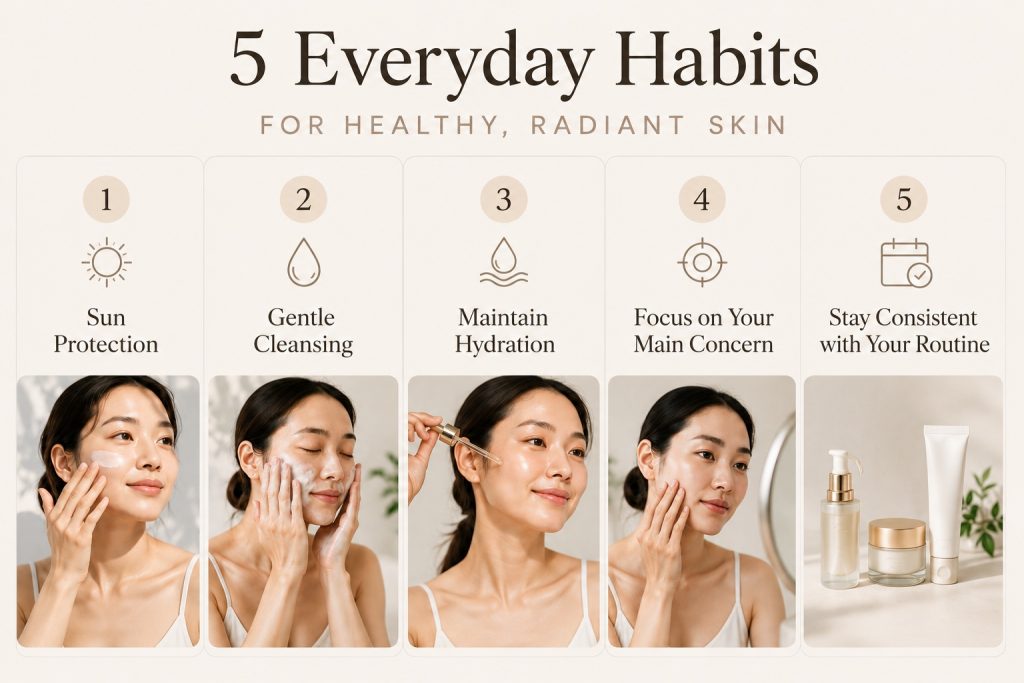
1. Make Sun Protection a Daily Habit
Use a broad-spectrum, water-resistant sunscreen with SPF 30 or higher.
When you’re outdoors for longer periods, combine sunscreen with shade, hats, sunglasses or protective clothing where practical.
2. Don’t Over-Cleanse
If you’ve spent the day sweating, cleansing can help remove sunscreen, makeup and surface impurities.
But “squeaky clean” isn’t necessarily the goal.
If your skin feels tight immediately after cleansing, reconsider whether your routine is too aggressive.
3. Maintain Hydration
If your skin feels dry or tight, look at your cleanser and moisturiser before automatically adding another active ingredient.
Moisturising helps trap water in the skin and can temporarily improve the appearance of some fine lines.
4. Focus on Your Main Concern
You don’t have to treat every sign of ageing at the same time.
If your main concern is pigmentation, focus on pigmentation and sun protection.
If it’s dryness, focus on hydration.
If fine lines are bothering you, build your routine around that concern.
The AAD similarly recommends addressing your primary ageing concern rather than layering several anti-ageing products at once.
5. Give Your Routine Time
Changing products every few days makes it difficult to know what is actually helping.
A simpler routine that you can follow consistently is easier to evaluate than a complicated routine that constantly changes.
When Might Skincare Not Feel Like Enough?
Daily skincare is the foundation.
But there are situations where people want additional professional care.
You might find yourself thinking:
“I’ve been consistent with my skincare, but my complexion still looks dull.”
Or:
“My skin feels dehydrated despite moisturising.”
Or:
“I’m noticing fine lines and reduced-looking firmness and want to explore professional treatment.”
That’s where a professional skin rejuvenation treatment may become another option.
The purpose isn’t to replace your skincare routine.
It’s to add another layer of cosmetic care based on your skin concerns and goals.
Skin Ageing Treatment Options: Which Approach May Suit Your Concern?
There is no single treatment that suits every sign of skin ageing. The more useful question is what are you actually noticing about your skin? The guide below matches common concerns with the approach that may be more relevant.
| What are you noticing? | Approach that may suit you | Why it may be relevant |
|---|---|---|
|
Fine lines and wrinkles are becoming more noticeable |
FountainCell™ 抗衰老疗法
|
A targeted professional treatment for visible signs of skin ageing, with a focus on fine lines, wrinkles and overall skin rejuvenation.
|
|
Your skin looks less firm or elastic than before
|
FountainCell™ 抗衰老疗法
|
More closely aligned with visible changes in firmness and elasticity, rather than a treatment focused mainly on hydration or radiance.
|
|
Your skin feels tight, dry or dehydrated
|
FountainCell™ 水合疗法
|
Centres on hydration and moisture replenishment, making it more appropriate when dryness and dehydration are affecting how the skin feels and looks.
|
|
Your complexion looks dull or tired
|
FountainCell™ 焕采疗程
|
Focuses on radiance and complexion, making it more relevant when the skin looks less fresh, luminous or refreshed.
|
|
Your skin tone looks uneven and lacks radiance |
FountainCell™ 焕采疗程
|
A radiance-focused approach that may be more relevant when uneven-looking tone is accompanied by dullness.
|
|
Your skin feels rough or looks uneven in texture
|
Exfoliation-focused facial
|
Focuses on surface renewal and can help refresh the appearance of rough or uneven-looking skin texture.
|
|
Your skin is oily, congested or has clogged pores
|
FountainCell™ 净化疗法
|
Takes a purification-focused approach for concerns such as excess oil, clogged pores and congestion, rather than focusing primarily on visible ageing.
|
|
You want to maintain your skin and reduce avoidable premature ageing
|
Daily skincare + sun protection
|
Provides the everyday foundation for skin ageing care, particularly through consistent UV protection, hydration and a suitable skincare routine.
|
|
You have several of these concerns at the same time
|
Skin analysis / professional consultation
|
Your concerns may require different approaches. Identifying which change is most noticeable can help determine where to start rather than choosing a treatment based on age alone.
|
|
You have new, changing or unexplained pigmentation or another unusual skin change
|
Medical skin assessment
|
A medical assessment is more appropriate when the change may require diagnosis rather than being assumed to be a cosmetic sign of skin ageing.
|
These options are not interchangeable. The most relevant approach depends on the specific change you want to address. For example, dryness and dehydration call for a different focus from fine lines and reduced-looking firmness, while dullness and congestion may require different treatment considerations again.
If you are experiencing several concerns at once, a skin analysis can help you identify which concern to prioritise before choosing a treatment.
HAACH's Approach to Ageing and Environmentally Stressed Skin
Once the basics are covered, professional treatment can be considered according to the concern you’re trying to address.
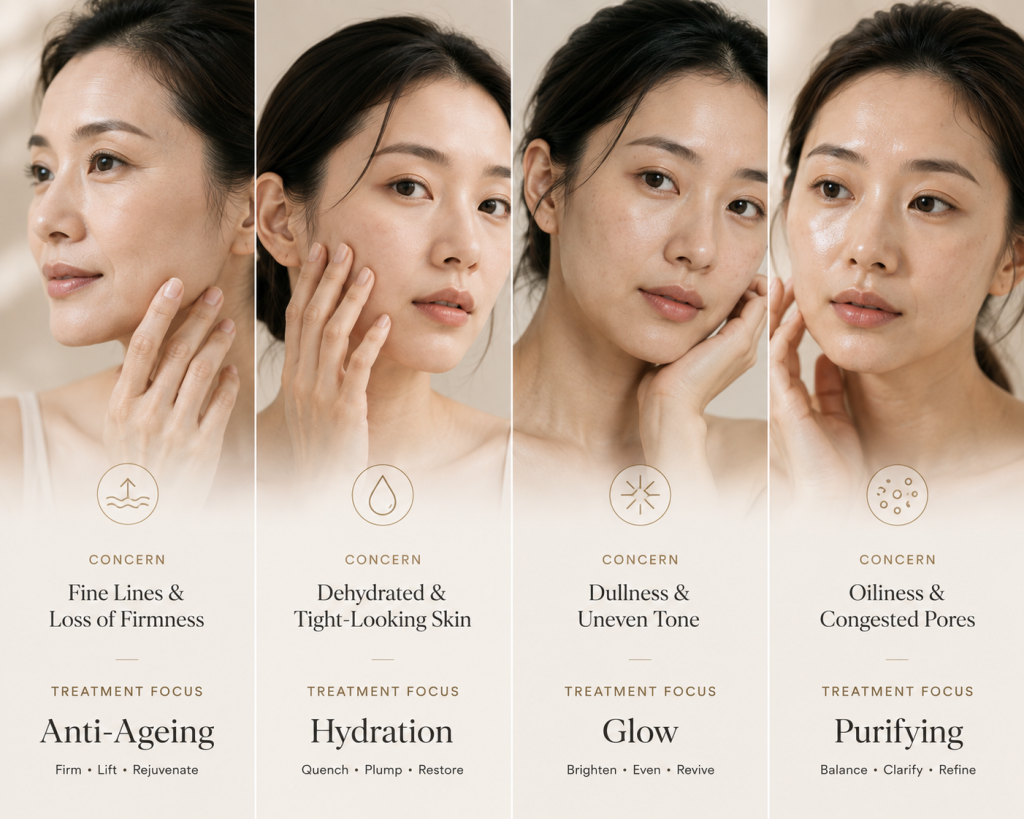
HAACH’s FountainCell™ range includes treatment options focused on ageing, hydration, radiance and purification.
Rather than thinking:
“I’m getting older, so I need an anti-ageing facial.”
It can be more useful to ask:
“What am I actually noticing about my skin?”
This helps shift the focus from age alone to the specific skin concerns you want to address.
Which FountainCell™ Treatment Is Most Relevant to Your Concern?
| Your concern | FountainCell™ option | Why it may be relevant |
|---|---|---|
|
Fine lines and wrinkles |
Addresses visible signs of skin ageing with a treatment approach centred on skin rejuvenation and the appearance of fine lines and wrinkles.
|
|
|
Reduced-looking firmness |
A more targeted consideration when the skin appears less firm or elastic, rather than simply lacking hydration or radiance.
|
|
|
Dryness or dehydration |
Centres on hydration and moisture replenishment, making it more suited to skin that feels tight, dry or lacking moisture.
|
|
|
Dull or tired-looking skin |
Focuses on restoring a more radiant-looking complexion, making it a natural consideration when skin appears tired or lacks luminosity.
|
|
|
Uneven-looking skin tone |
Places greater emphasis on radiance and complexion, which may make it more relevant when uneven-looking tone is accompanied by dullness.
|
|
|
Congested or impure-looking skin |
Takes a purification-focused approach, making it more relevant when excess oil, clogged pores or congestion are more noticeable.
|
|
|
Several concerns at once |
Discuss with HAACH
|
Skin concerns often overlap, so identifying which concern is most noticeable can help determine where to start rather than trying to address everything at once.
|
This guide offers a starting point for understanding which FountainCell™ treatment may best suit your skin concerns and goals. As every skin is unique, the right approach depends on your current skin condition, individual concerns and desired results. When several concerns overlap, a professional skin analysis or consultation can help you better understand your skin and identify the most suitable place to begin.
FountainCell™ Anti-Ageing Therapy at HAACH
For visible signs of skin ageing such as fine lines, wrinkles, reduced-looking firmness and elasticity, HAACH offers FountainCell™ Anti-Ageing Therapy.
The treatment follows a structured facial protocol that begins with double cleansing and gentle exfoliation to prepare the skin. This is followed by FountainCell™ infusion using the FountainCell™ Regenerative Bio-Cell Ampoule and NanoJet™ needle-free delivery technology, before concluding with a relaxing face and shoulder massage.
FountainCell™ Anti-Ageing Therapy is a non-invasive treatment at HAACH that takes approximately 90 minutes and is suitable for all skin types. It is particularly suited to skin concerns associated with ageing and dryness, with the treatment focused on enhancing the skin’s hydration, smoothness and overall appearance for a more refreshed and revitalised look.
FountainCell™ 水合疗法
If your main concern is dryness or dehydrated-looking skin, a hydration-focused treatment may be more relevant than choosing an anti-ageing treatment simply because you are getting older.
HAACH’s FountainCell™ Hydration Therapy focuses on intense hydration and replenishing moisture, using FountainCell™ and NanoJet™ technology. This may be relevant if your skin often feels affected by Singapore’s humid outdoor conditions, sweating and prolonged exposure to air-conditioning, leaving it feeling dry or tight at times.
The aim is to match the treatment to the concern you actually want to address, rather than assuming that everyone needs the same approach.
FountainCell™ 焕采疗程
Not everyone searching for “skin rejuvenation” is primarily concerned about wrinkles.
Sometimes the concern is simpler:
“My skin just looks tired.”
HAACH’s FountainCell™ Glow Therapy focuses on radiance, dullness and uneven-looking skin tone.
FountainCell™ Glow Therapy combines FountainCell™ infusion with NanoJet™ technology, followed by gentle exfoliation and a relaxing face and shoulder massage. The treatment takes approximately 90 minutes and is suitable for all skin types, particularly skin that appears dull or uneven in tone. It is designed to refresh the complexion and enhance the skin’s overall radiance for a smoother, more luminous-looking finish.
FountainCell™ 净化疗法
If your main concern is oiliness, clogged pores or congestion rather than visible ageing, FountainCell™ Purifying Therapy may be the more relevant FountainCell™ option.
HAACH describes the treatment around concerns including excess oil, clogged pores, enlarged pores, acne-prone skin and dullness.
The treatment includes cleansing, exfoliation and FountainCell™ infusion using NanoJet™ technology.
This is a useful distinction because a skin ageing treatment isn’t necessarily the right starting point for every skin concern.
Everyday Skincare vs FountainCell™
Professional treatment and daily skincare serve different purposes.Professional treatment and daily skincare serve different purposes.
| Attribute | Everyday skincare | FountainCell™ |
|---|---|---|
|
Frequency |
Regular or daily use as part of your skincare routine
|
Periodic professional treatment
|
|
Main role |
Ongoing care, maintenance and support for the skin
|
Adds a professional treatment layer focused on specific skin concerns
|
|
Sun protection |
Essential for everyday skin protection
|
Still essential before and after professional treatment
|
|
Hydration |
Supports skin hydration through daily products and routine
|
Can be a dedicated treatment focus through FountainCell™ Hydration Therapy
|
|
Radiance |
Supported through skincare, lifestyle and consistent care
|
Can be a professional treatment focus through FountainCell™ Glow Therapy
|
|
Visible ageing |
Provides ongoing care for the appearance of ageing skin
|
Can provide a professional treatment approach for visible signs of ageing
|
|
Technology |
Depends on the products and skincare routine used
|
Uses FountainCell™ with NanoJet™ needle-free delivery technology
|
|
Personalisation |
Based on your skin type, products, routine and concerns
|
Based on your skin concerns, treatment goals and selected treatment approach
|
FountainCell™ is not intended to replace your everyday skincare routine. Daily skincare remains important for ongoing maintenance and sun protection, while professional treatment can provide an additional layer of care based on specific skin concerns and treatment goals.
When Should You See a Doctor Instead?
Not every skin concern should be treated as a cosmetic ageing issue.
Seek appropriate medical assessment if you notice:
- A new or changing mole
- Rapidly changing pigmentation
- A persistent rash
- A new or persistent skin lesion
- Unexplained bleeding or crusting
- A skin change that concerns you
A professional facial can support cosmetic skin concerns, but it should not be used as a substitute for medical assessment.
The Bottom Line: Caring for Ageing Skin in Singapore
Skin ageing is a natural part of getting older, but living in Singapore means your skin is also exposed to environmental factors that can influence how it looks over time.
UV exposure deserves particular attention, while heat, sweating, humidity, air-conditioning, pollution and lifestyle can all affect your skin in different ways.
The foundation remains simple:
Protect your skin from UV exposure, keep it appropriately hydrated, avoid overly aggressive cleansing, maintain a consistent skincare routine and support your overall health.
If you’re looking for additional professional care, start with the concern you actually want to address.
HAACH offers FountainCell™ Anti-Ageing, Hydration, Glow and Purifying therapies for different skin concerns.
The goal isn’t to stop ageing.
It’s to understand what your skin needs and choose the right combination of daily care and professional treatment to support it.
Explore Skin Rejuvenation at HAACH
If your skin is looking dull, dehydrated or increasingly affected by visible signs of skin ageing, the first step is to understand what your skin actually needs. HAACH offers FountainCell™ Anti-Ageing, Hydration, Glow and Purifying therapies, each designed around different skin concerns.
Not sure which treatment is right for you? Book a Skin Analysis to better understand your skin concerns and identify where to start.
Already know what you want to address? Explore FountainCell™ to compare the different treatment options, or Book a FountainCell™ Facial at HAACH.
If fine lines, wrinkles, reduced-looking firmness or elasticity are your main concerns, book FountainCell™ Anti-Ageing Therapy for a professional skin rejuvenation treatment focused on visible signs of skin ageing.
Understand your skin. Choose the right approach. Take the next step with HAACH.
预约
现在就到附近的HAACH 分店预约。
Frequently Asked Questions About Skin Ageing in Singapore
Skin ageing results from a combination of natural ageing and external factors.
In Singapore, cumulative UV exposure is particularly relevant because the UV Index can reach Very High and Extreme levels around midday under suitable conditions.
Lifestyle factors such as smoking and skincare habits can also influence premature visible ageing.
Heat itself is not a direct cause of biological skin ageing.
However, heat and sweating can affect how oily or congested skin feels. UV exposure, which often accompanies outdoor activity, is a much more important factor when discussing premature visible ageing.
No. Humidity itself isn’t a direct cause of skin ageing.
High humidity can increase sweating and make skin feel oilier, while air-conditioning, cleansing habits and skincare products can affect how dry or comfortable the skin feels.
Yes. Oil and hydration are different things. Your skin can produce excess sebum while still feeling tight, dry or lacking suppleness.
Outdoor humidity isn’t the only factor affecting your skin. Air-conditioning, cleansing habits, skincare products and your individual skin condition can all influence how hydrated or comfortable your skin feels.
Environmental pollution can contribute to skin stress, but it is only one possible factor. UV exposure, natural ageing, lifestyle and skincare habits also play important roles in visible skin ageing.
UV exposure can contribute to pigmentation and uneven skin tone. However, not every pigmented area is caused by the sun. New, changing or unusual pigmentation should be assessed appropriately rather than automatically assumed to be sun damage.
Regular sun protection can help reduce premature skin ageing associated with UV exposure.
The AAD recommends broad-spectrum, water-resistant sunscreen with SPF 30 or higher, together with shade and protective clothing where appropriate.
Daily sun protection is a sensible part of a skin-ageing prevention routine. UV exposure isn’t limited to beach days. Commuting, walking outdoors and other everyday activities contribute to cumulative exposure.
When outdoors, the AAD recommends reapplying approximately every two hours and after swimming or sweating, while following the directions for your particular sunscreen.
Yes. Dry skin can make fine lines appear more noticeable. Moisturising can help the skin retain water and temporarily improve the appearance of some fine lines.
There is no single treatment that is right for everyone. Different skin concerns call for different approaches. Fine lines and reduced-looking firmness, for example, may require a different focus from dryness, dehydration, dullness or uneven-looking skin tone.
It depends on which signs of ageing concern you most.
If your main concerns are fine lines, wrinkles, firmness or elasticity, a treatment specifically designed around those concerns may be more relevant than a general cleansing facial.
At HAACH, FountainCell™ Anti-Ageing Therapy is designed for visible signs of skin ageing such as fine lines, wrinkles, firmness and elasticity.
FountainCell™ Anti-Ageing Therapy is HAACH’s treatment for visible signs of skin ageing.
It incorporates FountainCell™, NanoJet™ technology and light therapy as part of the treatment protocol.
FountainCell™ Hydration Therapy is HAACH’s FountainCell™ option focused on hydration.
If your skin feels dry, tight or dehydrated, FountainCell™ Hydration Therapy may be a more relevant option. The treatment focuses on replenishing moisture using FountainCell™ and NanoJet™ technology, making it particularly suited to hydration-related skin concerns.
For dull or uneven-looking skin, FountainCell™ Glow Therapy focuses on improving the appearance of radiance and complexion.
FountainCell™ Purifying Therapy is the FountainCell™ option focused on excess oil, clogged pores and congestion.
It may be suitable for people concerned about visible signs of ageing, depending on their skin condition and treatment goals.
HAACH’s FountainCell™ Anti-Ageing Therapy is designed around concerns such as fine lines, wrinkles, firmness and elasticity.
FountainCell™ is designed as a professional cosmetic skin rejuvenation treatment to support the appearance and condition of the skin. While it can address visible signs of skin ageing, it does not stop or reverse the natural ageing process.
Not necessarily. Conventional facials and FountainCell™ treatments are designed with different goals in mind. A conventional facial may focus on cleansing, exfoliation, hydration or relaxation, while FountainCell™ uses the FountainCell™ Regenerative Bio-Cell Ampoule with NanoJet™ needle-free delivery technology to provide a more targeted approach to specific skin concerns.
NanoJet™ is HAACH’s needle-free delivery technology used to deliver the FountainCell™ Regenerative Bio-Cell Ampoule during treatment. Rather than relying on conventional needles, NanoJet™ breaks the ampoule into extremely fine, nano-sized particles or droplets, helping the formulation move beyond the skin’s surface and into deeper layers. This allows FountainCell™ to be delivered through a non-invasive approach while supporting the treatment’s skin rejuvenation goals.
The post-treatment experience can vary depending on the treatment and individual skin condition.
Ask HAACH what to expect after your specific treatment and what aftercare is recommended.
HAACH recommends a 3–4 week interval between FountainCell™ Anti-Ageing and Glow treatments. The ideal frequency may vary depending on your skin condition and treatment goals, so a HAACH skincare expert can help you determine a schedule suited to your needs.
Yes, but follow HAACH’s post-treatment guidance. Your normal routine may need to be adjusted depending on the treatment and how your skin responds.
It depends on what is causing the pigmentation.Cosmetic pigmentation concerns can have different causes. If you notice new, rapidly changing or unusual pigmentation, seek appropriate medical assessment rather than relying on a facial.